

ACTIA IME
Vehicle Diagnostics
ACTIA as an expert in vehicle diagnostics
Here you will find comprehensive information to help you understand the vehicle diagnostics of modern vehicles and get to know our experts, our field of activity and our products better. Discover how our services and innovative solutions can help you to master the current challenges of diagnostics with confidence.
Vehicle Diagnostics
Vehicle diagnostics is a key success factor in the development, production, and operation of modern vehicles. Increasing software content, connected systems, electromobility, and automated driving functions significantly increase the complexity of vehicle electronic architectures. ACTIA IME provides powerful, scalable diagnostic solutions tailored to your specific requirements.
Fundamentals: Vehicle Diagnostics Based on the OSI Layer Model
To support the structured development and analysis of modern diagnostic systems, the OSI (Open Systems Interconnection) model is widely used in vehicle diagnostics. It describes data communication across seven clearly defined layers, ranging from physical data transmission to processing within the diagnostic application.
Benefits for our customers:
- Modularity and interchangeability of individual components
- Clear system separation between hardware, protocols, and software
- Future-proof support for new vehicle architectures
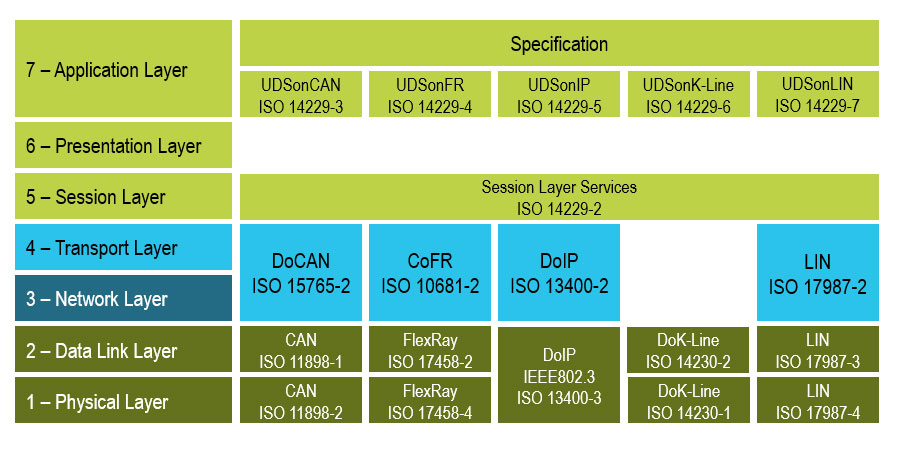
OSI Layer Model: Each layer performs a clearly defined function and operates largely independently of the others. This allows individual technologies or components to be replaced without affecting the functionality of the overall system.
Bus systems
Bus systems form the physical foundation of vehicle diagnostics. While earlier vehicle generations relied on simple serial communication lines, modern vehicles require significantly higher data rates, real-time capabilities, and improved robustness against interference. In particular, cameras, radar sensors, and other environmental sensing systems generate large volumes of data that must be processed and diagnosed reliably.
At the same time, vehicle architectures are undergoing a fundamental transformation: centralized High-Performance Computers (HPCs) are increasingly replacing large numbers of distributed electronic control units (ECUs).
Typical bus systems:
K-Line
ISO 9141
CAN
ISO 11898
(Controller Area Network)
CAN-FD
ISO 11898-1
(CAN with Flexible Datarate)
CAN-XL
ISO 11898-1
(CAN Extra Long)
Ethernet
ISO 13400 (DoIP)
FlexRay
ISO 17458
ISOBUS
ISO 11783
LIN
ISO 17987-1
(Local Interconnect Network)
MOST
(Media Oriented Systems Transport)
SAE J1708
SAE J1850
Diagnostic protocols
Building on the underlying bus systems, diagnostic and transport protocols ensure standardized and interoperable communication between diagnostic testers and electronic control units (ECUs). Modern vehicles often use multiple protocols in parallel, particularly during transition phases between vehicle platforms.
ACTIA IME has extensive experience in multi-protocol diagnostic environments, providing a decisive advantage for platform strategies and global vehicle programs.
Supported transport and diagnostic protocols:
DoIP
ISO 13400
(Diagnostic over Internet Protocol)
ISO-TP
ISO 15765-2
(ISO Transport Protocol)
SAE J1939
TP1.6/2.0
KWP 2000 on K-Line
ISO 14230
(Keyword Protocol 2000)
KWP 2000 on CAN
ISO/DIS 15765
(Keyword Protocol 2000)
UDS
ISO 14229
OBD
SAE J1939
WWH-OBD
ISO 27145
Diagnostic APIs – Efficiency Through Standardized Interfaces
As bus systems and protocols became increasingly standardized, the need for consistent Application Programming Interfaces (APIs) also grew. The goal is to make diagnostic applications, and especially their interfaces to Vehicle Communication Interfaces (VCIs), interchangeable and independent of specific manufacturers.
Typical diagnostic APIs:
D-PDU API
ISO 22900-2
D-Server
ISO 22900-3
OTX
ISO 13209
PassThru
SAE J2534
RP 1210
TMC
SOVD
ISO 17987