
CAN-FD – ISO 11898-1
Following the widespread adoption of the CAN bus throughout the automotive industry, it became clear that the current diagnostic communication system required greater data volume and speed. For this reason, Robert Bosch GmbH introduced CAN-FD in 2012. The abbreviation FD stands for ‘flexible data rate’ and is specified in ISO 11898-1. Key changes include expanding the payload field from 8 bytes to up to 64 bytes per frame and increasing the data rate from a maximum of 1 Mbit/s to 8 Mbit/s. CAN-FD therefore places significantly higher demands on the processing speed of ECUs and is typically used by newer, high-performance ECUs.
The CAN-FD standard is backward compatible with the conventional CAN standard. For example, both normal (11-bit) and extended (29-bit) addressing are supported for the identifier.
Comparison of CAN and CAN FD
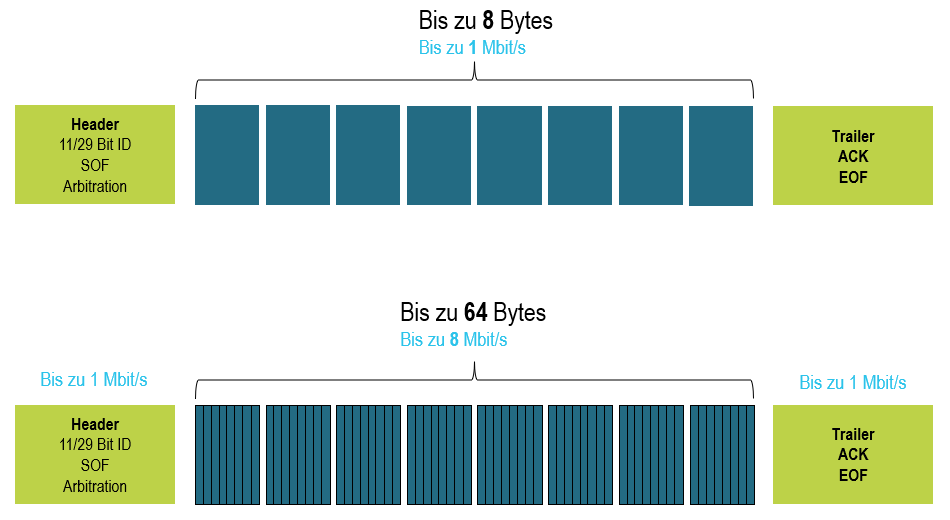
The distinction between CAN and CAN-FD frames is made using one of the “Reserved” bits in the control field, the FDF bit (FD Frame). If this bit is set, the following frame is interpreted as a CAN-FD frame. In this case, the second data rate is used to transmit the payload data using the newly introduced BRS (Bit Rate Switch).
The data rate is set using the DLC field:
| No. of data bytes | DLC3 | DLC2 | DLC1 | DLC0 |
| 0..8 | as classical CAN | |||
| 12 | rezessive | dominant | dominant | rezessive |
| 16 | rezessive | dominant | rezessive | dominant |
| 20 | rezessive | dominant | rezessive | rezessive |
| 24 | rezessive | rezessive | dominant | dominant |
| 32 | rezessive | rezessive | dominant | rezessive |
| 48 | rezessive | rezessive | rezessive | dominant |
| 64 | rezessive | rezessive | rezessive | rezessive |

Do you have any questions about our products or services?
We are here for you! Send us your inquiry using the contact form – our team will get back to you as soon as possible.