
LIN – ISO 17987-1
The LIN bus (Local Interconnect Network) was developed as a cost-effective complement to the CAN bus. Smaller subnets are typically connected to the vehicle’s CAN bus via the LIN bus, usually through a bridge. This is accomplished using a serial structure.
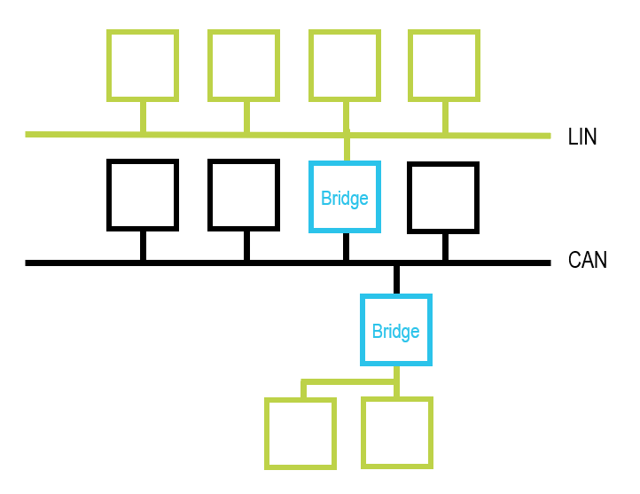
The LIN bus was introduced in 1999 by a consortium of various automakers for use in automobiles. The primary goal was to support non-time-critical and less data-intensive applications. Typical examples include air conditioning systems and door control units. The LIN bus is physically implemented using a single-wire copper cable.
The LIN bus specification was developed by the LIN Consortium through 2010 and reached its final version with 2.2A. It was incorporated into ISO Standard 17987-1, “Road vehicles – Local Interconnect Network (LIN) – Parts 1–8.”
To ensure that supplier IDs are unique, they are still managed today by the CiA (CAN in Automation) in Nuremberg. Assigned IDs can be looked up under “Supplier ID.”
Topology
A LIN bus network consists of a master and several slave nodes (usually a maximum of 16). The master initiates the transmission by sending a so-called header. This header defines an entry in a given configuration table. This table specifies which node is to send the up to 8 bytes of a message, what type of message it is, and for which node the message is relevant.
Specifications
Data transfer rates of up to 20 kbit/s are possible. However, data rates of 2.4 kbit/s, 9.6 kbit/s, or 19.2 kbit/s are recommended. The network supports the “Sleep” and ‘Normal’ states. Switching between these states is accomplished via a so-called “wake-up signal” frame. The bus’s sleep state makes it possible to conserve energy.
Frame Construction
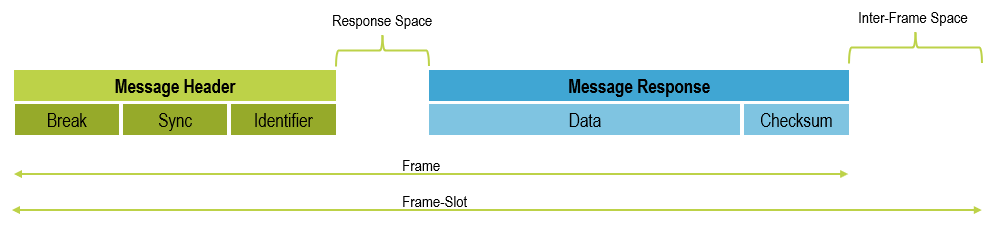
| Type | Description |
| BREAK | The break consists of 13 dominant bits, followed by a separator (1 recessive bit). This break notifies all nodes that the sequence has begun. |
| SYNC | The SYNC field corresponds to the hexadecimal value 0x55 and is used by slave devices for automatic baud rate detection. These devices can measure the edge intervals here and thus configure themselves to the appropriate baud rate. |
| ID | The ID uniquely identifies each of the maximum possible messages on the network. Upon receipt, each node determines whether it should send or receive this identifier, and either responds accordingly or discards the message. |
| DATA | Between 1 and 8 bytes of payload data |
| CHECKSUM | The checksum is included in the response. The LIN bus specification provides two different methods for calculating the checksum, which can be configured |

Do you have any questions about our products or services?
We are here for you! Send us your inquiry using the contact form – our team will get back to you as soon as possible.