
FlexRay – ISO 17458
FlexRay is a serial, deterministic, and fault-tolerant fieldbus system designed for use in the automotive industry. It was developed primarily for use in X-by-Wire applications. These applications require a higher data transfer rate than can be achieved with the CAN bus. To ensure rapid and cost-effective implementation, the leading German automakers collaborated on this new development. The goal was to create a new open standard similar to the CAN bus.
Physical Layer and Topology
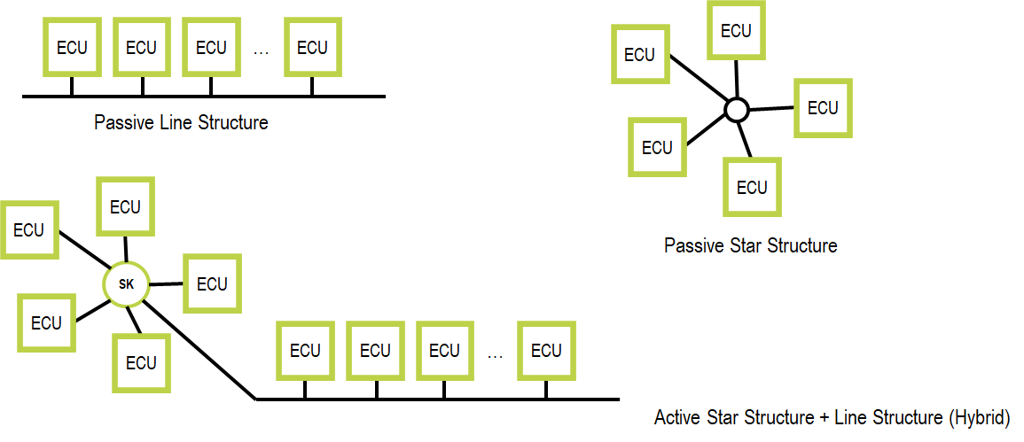
In principle, it is also possible to use a line topology with FlexRay, similar to that used with the CAN bus. Ideally, however, the active star topology is used, in which the star point actively generates the required signals. Hybrid configurations combining both variants are also feasible.
Sequence:
Communication takes place in the following cycles:
- Static Segment
Each control unit has its own fixed slot. This slot must not be exceeded. If the message is longer, an additional slot or the dynamic segment must be used. The static segment ensures determinism for time-critical messages. - Dynamic Segment
In this segment, longer messages can be sent via the control unit. - Symbol Window
This feature is obsolete; it was originally intended for testing the bus system. - NIT (Network Idle Time)
This allows control units to resynchronize with the bus.
Features:
- Bit rates up to 10 Mbit/s per channel
- Decentralized clock synchronization
- Guaranteed latency times
- Dual-channel support in the protocol (redundancy for safety-critical applications)
- Centralized and Decentralized Access Control
- Star topology, buses on the star arms
- Max. 64 control units per segment
- Max. distance/bus length to the neutral point: max. 24 m

Do you have any questions about our products or services?
We are here for you! Send us your inquiry using the contact form – our team will get back to you as soon as possible.